Termites are widely considered to be among the most destructive insect pests in the world. Every year, countless buildings and structures across Kenya suffer damage caused by these pests, resulting in significant financial losses for homeowners and business owners alike. Understanding the different termite species found in Kenya, and how each one behaves, is an important first step in protecting your property effectively.
At Pestraid Kenya, our technicians are trained to identify termite species accurately and recommend the most suitable treatment approach based on the specific type of termite affecting your property. Correct identification matters, because different termite species behave differently, nest differently, and require different treatment strategies to eliminate effectively.
📞 Call Pestraid Kenya today on 0710 907 628
📧 Email: sales@pestraid.co.ke
Termite Species Found in Kenya
There are various termite species present across Kenya, but only a handful are responsible for the majority of property damage reported each year. The three main species of concern are:
- Neotermes spp (dampwood termites)
- Coptotermes spp (subterranean termites)
- Cryptotermes spp (drywood termites, native to the region)
Of these three, it is the Coptotermes and Cryptotermes species that cause the most significant damage to buildings and structures across Kenya, making them the primary focus of most termite control and prevention efforts.
Understanding Termite Society
Termites live in highly organised colonies, structured around distinct castes that each perform a specific role. Understanding this social structure helps explain why termite colonies are so resilient, and why effective treatment needs to address the colony as a whole rather than simply targeting visible termites.
The basic castes within a termite colony are the queen and king, workers, soldiers, and alates.
Termite Queen and King: Giving Life to the Colony
The queen and king are responsible for reproduction within the colony. Both begin life as alates. At a certain stage, they leave their parents’ colony, drop to the ground, and shed their wings in search of a suitable environment to establish a new nest. Once settled, the queen and king care for their young until the offspring are mature enough to take over the various duties required to sustain and grow the colony.
Termite Workers: The Doers
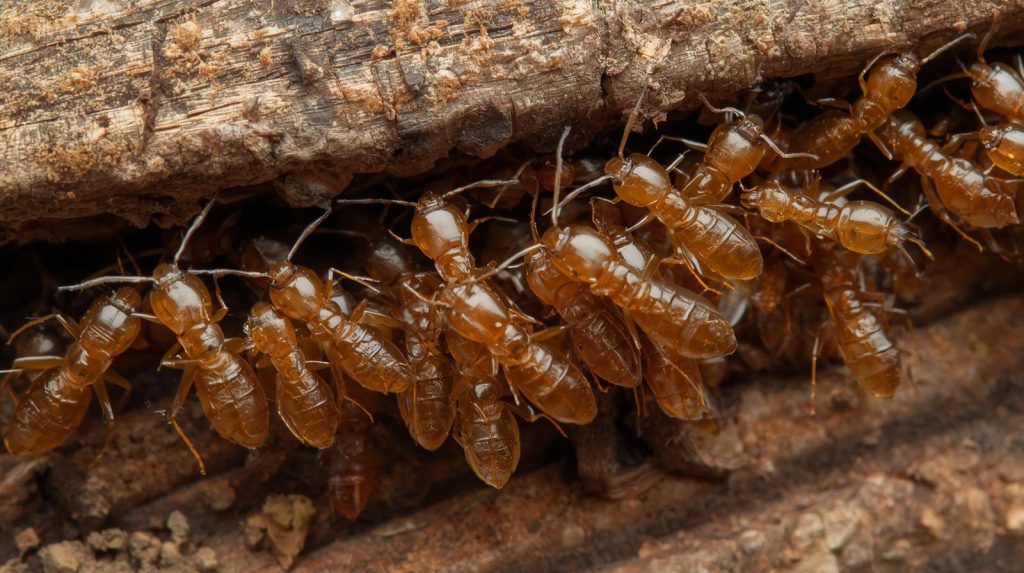
Workers make up the largest proportion of individuals within a termite colony. They are responsible for nearly all of the colony’s labour, including feeding other members, grooming, excavating the nest, and constructing tunnels. It is through carrying out these everyday tasks that worker termites cause the widespread structural destruction that affects so many homes and buildings across Kenya.
Termite Soldiers: The Colony’s Defence
Soldiers are responsible for defending the colony against external threats, particularly predatory enemies such as ants. To carry out this role, soldier termites are equipped with specialised defence mechanisms, including large, powerful jaws, sticky defensive fluids, or in some species, a chemical spray used to fend off attackers.
Alates: The Future Queens and Kings
Alates are the winged reproductive members of the colony. When conditions are right, alates swarm out from the nest in large numbers to establish entirely new colonies elsewhere. During this process, males and females pair off and search together for a suitable environment in which to mate and begin a new colony. Alates are often mistaken for moths due to their appearance and swarming behaviour, which can make early identification confusing for property owners.
Coptotermes spp: Subterranean Termites
Family: Rhinotermitidae (subfamily Coptotermitidae)
Genus: Coptotermes
Type: Subterranean
Castes: Queen, king, soldier, worker, reproductive
Coptotermes termites are mud tunnel builders. Because they rely on underground food sources but sometimes need to travel above the surface of the ground to reach timber, they construct distinctive mud tunnels to do so safely. These tunnels serve two important purposes. First, they help control humidity levels around the termites, preventing them from drying out. Second, they offer protection from natural predators such as ants.
Coptotermes termites are soft bodied insects that depend heavily on high humidity and moisture to survive, largely because their outer skin is highly permeable, allowing constant moisture and gas exchange with their surroundings. Within the soil, they are able to regulate humidity levels effectively, creating an ideal living environment for the colony.
As their name suggests, subterranean termites nest underground. They move below the surface of the ground as much as possible, building short tunnels to travel discreetly from one point of cover to another. This behaviour makes detection particularly challenging, since very little activity is visible above ground until significant damage has already occurred.
Coptotermes is considered one of the most destructive termite species in Kenya. It attacks all types of timber structures found within buildings and is also known to cause considerable damage to trees.
Cryptotermes spp: Drywood Termites
Family: Kalotermitidae (subfamily Cryptotermes)
Genus: Cryptotermes
Type: Drywood
Castes: Queen, king, soldier, reproductive
Drywood termites live entirely inside the wood they infest. When a piece of timber becomes infested with drywood termites, the entire colony is effectively sealed inside that piece of wood, operating completely out of sight.
These termites eat galleries from the inside of the timber outward, gradually hollowing out the wood until only a thin outer shell remains intact. This method of feeding makes a drywood termite infestation extremely difficult to detect during its early stages, since the exterior of the timber often shows little to no visible damage while the interior is being consumed.
In most cases, drywood termite activity is only discovered once significant damage has already occurred, often when a section of timber structure gives way or is found to be hollow. Treatment for drywood termite infestations typically requires replacing the affected section of wooden structure, along with treatment of a wider surrounding area to ensure the infestation has been fully addressed.
Neotermes spp: Dampwood Termites
Family: Kalotermitidae (subfamily Neotermes)
Genus: Neotermes
Type: Dampwood
Castes: Queen, king, soldier, worker, reproductive
Dampwood termites generally live within damp, rotting logs or within rotten pockets found in dead or living trees. They can be found throughout Kenya, typically infesting timber with a high moisture content.
Neotermes termites share some behavioural similarities with leaf cutting ants. However, they differ significantly from the other termite species discussed above in terms of food preference. While subterranean and drywood termites primarily target timber, dampwood termites feed largely on grass, making them a particular concern for property owners with lawns and landscaped gardens. It has also been observed that dampwood termites can target thatch roofing, which can lead to costly and unexpected damage for property owners with thatched structures.
One notable difference from an identification standpoint is that although dampwood termites are soft bodied, they are sclerotized, meaning their outer skin is somewhat hardened and therefore less permeable than that of subterranean termites. This makes them more resilient to drying out compared to other species.
In terms of appearance, dampwood termites are generally darker in colour, ranging from yellow to dark brown, compared to the whitish or creamy colouring seen in subterranean and drywood termites. They are also frequently seen moving freely above the surface, behaving in a manner quite similar to ants, which can sometimes lead to misidentification.
Why Correct Termite Identification Matters
Because each of these termite species nests differently, feeds differently, and responds to different treatment methods, correctly identifying which species is present on your property is an essential first step toward effective control. A treatment approach designed for subterranean termites, for example, will not necessarily be effective against a drywood termite infestation confined entirely within a single timber structure.
This is why professional inspection and identification, carried out by trained termite control technicians, is so important. Attempting to treat a termite problem without first identifying the species involved can lead to wasted time, unnecessary expense, and a treatment that fails to fully resolve the infestation.
Get Expert Termite Identification and Treatment from Pestraid Kenya
Whether you are dealing with mud tunnels along your foundation, hollow sounding timber, damage to thatch roofing, or simply want to understand your property’s termite risk, Pestraid Kenya’s trained technicians have the expertise to accurately identify the termite species involved and recommend the most effective treatment plan for your specific situation.
Wherever you are located across Kenya, from Nairobi and Mombasa to Nakuru and Kisumu, our team is ready to help protect your property from the destructive impact of termite infestation.
📞 Contact Pestraid Kenya today at 0710 907 628 to arrange a professional termite inspection and identification.
📧 Email: sales@pestraid.co.ke