Meta Title: How to Control Termites in Kenya (Best Chemicals & Expert Treatment Methods 2026) | Pestraid Kenya Meta Description: Termites destroying your home in Kenya? Pestraid Kenya shares the best termiticides, professional soil treatment methods, and expert tips to permanently eliminate termites from your property in 2026. Call 0710907628. Focus Keyword: how to control termites in Kenya Secondary Keywords: termite treatment Kenya, best termite chemical Kenya 2026, termite control Nairobi, termite fumigation Kenya, soil treatment for termites Kenya, Pestraid Kenya termites
Termites are the single most destructive pest in Kenya. Unlike cockroaches or bed bugs that cause health and comfort problems, termites silently destroy the structural integrity of your home — eating through timber, furniture, door frames, roof trusses, and even paper and fabric — often for years before any visible damage is noticed. By the time most Kenyan homeowners discover a termite problem, thousands of shillings worth of damage has already been done.
In Kenya’s warm, humid climate — particularly in cities like Nairobi, Mombasa, Kisumu, and Eldoret — termite colonies thrive year-round. A single subterranean termite colony can contain over one million workers and cause catastrophic structural damage within 3–5 years if left untreated.
This complete 2026 guide from Pestraid Kenya covers everything you need to know: how to identify termites, the best chemicals available in Kenya, professional treatment methods, and how to protect your property long-term.
📞 Call or WhatsApp Pestraid Kenya: 0710907628 ✉️ Email: sales@pestraid.co.ke
Table of Contents
- Why Termites Are Kenya’s Most Dangerous Pest
- Types of Termites Found in Kenya
- Warning Signs of a Termite Infestation
- Where Termites Attack: High-Risk Areas in Your Property
- Termite Treatment Methods Explained
- Best Termite Control Chemicals in Kenya (2026 Comparison)
- Our Top Recommended Termiticide Products
- Step-by-Step Professional Termite Treatment Process
- DIY Termite Control: What Works and What Doesn’t
- How to Protect a New Building from Termites in Kenya
- How to Prevent Termites from Returning
- Frequently Asked Questions
- Contact Pestraid Kenya
1. Why Termites Are Kenya’s Most Dangerous Pest
Termites are often called the “silent destroyers” — and for good reason. They work 24 hours a day, 7 days a week, hidden inside walls, under floors, and underground. By the time mud tubes appear on walls or winged termites swarm inside your home, the colony has usually been present for 2–5 years and has already caused significant hidden damage.
In Kenya, the economic impact of termites is enormous. Studies estimate that termites cause billions of shillings in property damage annually across East Africa. Roofing timbers collapse, door frames crumble, flooring weakens, and furniture is hollowed out — all from the inside, making early detection extremely difficult.
The challenge is compounded by Kenya’s tropical climate. Termites thrive in warm, moist soil — conditions that are present year-round across most of Kenya. The long rainy seasons accelerate colony growth and trigger swarming events, during which winged reproductives (alates) fly out to establish new colonies in neighbouring properties.
Pestraid Kenya Expert Insight: We have treated properties in Nairobi where termites had fully hollowed out roof rafters while the homeowner assumed the occasional mud trail was just dirt. Regular termite inspections are essential — especially for properties built on red murram soil, which subterranean termites favour heavily.
2. Types of Termites Found in Kenya
Kenya is home to several termite species, each with different behaviours, colony sizes, and damage patterns. Identifying the correct species is critical to selecting the right treatment method.
| Species | Common Name | Colony Size | Nesting Habit | Primary Damage | Threat Level |
|---|---|---|---|---|---|
| Macrotermes michaelseni | Mound Termite / Fungus Termite | 1–3 million | Underground with large mounds | Timber, furniture, crops, structures | 🔴 Very High |
| Microtermes spp. | Subterranean Termite | 100,000–500,000 | Underground, no visible mound | Timber, roots, building foundations | 🔴 Very High |
| Coptotermes formosanus | Formosan Termite | 1–10 million | Underground and in wood | Structural timber, hardwood | 🔴 Extreme |
| Nasutitermes spp. | Tree / Arboreal Termite | 10,000–100,000 | In trees and wooden structures | Furniture, door frames, wooden floors | 🟠 High |
| Cryptotermes spp. | Drywood Termite | 1,000–10,000 | Inside dry wood — no soil contact | Furniture, roof timbers, flooring | 🟠 High |
| Trinervitermes spp. | Harvester Termite | 50,000–200,000 | Underground | Grass, crops, thatch roofing | 🟡 Moderate |
Key Distinction: Subterranean termites (the most destructive in Kenya) require soil contact and moisture. Drywood termites live entirely inside wood with no soil contact, requiring different treatment approaches. Correctly identifying the species determines whether soil treatment, wood treatment, or fumigation is the right solution.
3. Warning Signs of a Termite Infestation
Early detection can save you hundreds of thousands of shillings in repair costs. Here are the key warning signs Pestraid Kenya’s inspectors look for:
Mud Tubes (Shelter Tubes) Subterranean termites build pencil-thin mud tubes along walls, foundations, pipes, and structural timber to protect themselves from light and air as they travel between soil and food sources. These are the most reliable visible sign of subterranean termite activity.
Swarming Alates (Flying Termites) Winged termites emerging from walls, floors, or soil — especially after heavy rains — signal an established, mature colony nearby. Finding discarded wings around window sills and door frames is equally significant.
Hollow-Sounding Timber Tap wooden door frames, skirting boards, window frames, and floor boards. Termite-damaged wood sounds hollow or papery — the interior has been eaten away while the outer surface remains intact.
Frass (Termite Droppings) Drywood termites push their droppings (small, pellet-shaped frass) out of small holes in the wood. Finding tiny piles of sand-like pellets near wooden furniture or fittings is a strong indicator of drywood termite activity.
Tight-Fitting Doors and Windows As termites eat through frames and produce moisture, timber expands and warps — causing doors and windows to suddenly stick or not close properly.
Visible Damage to Timber In advanced infestations, timber shows visible tunnels, grooves along the wood grain, or collapses entirely when pressed. Check the underside of wooden floors and the back of skirting boards.
Cracked or Bubbling Paint Termites produce moisture as they work inside walls, causing paint to bubble, crack, or appear water-damaged even in areas with no plumbing.
Soil Mounds Near the Property Large conical mounds of brown soil near or on the property are nesting sites of Macrotermes termites. Even if the mound is some distance away, underground foraging tunnels may extend 50–100 metres into your property.
4. Where Termites Attack: High-Risk Areas in Your Property
| Area of Property | What Termites Target | Risk Level |
|---|---|---|
| Roof trusses and rafters | Structural timber — can cause roof collapse | 🔴 Critical |
| Foundation and sub-floor | Timber beams in contact with or near soil | 🔴 Critical |
| Door and window frames | Soft timber in wall openings | 🔴 High |
| Wooden flooring and parquet | Underside of floor boards, adhesive, and timber sub-floor | 🔴 High |
| Kitchen and bathroom cabinets | Timber in contact with plumbing moisture | 🟠 High |
| Furniture and wardrobes | Chipboard, MDF, and solid wood | 🟠 High |
| Skirting boards and wall panelling | Timber along wall-floor junction | 🟠 High |
| Garden fencing and gates | Untreated timber in direct soil contact | 🟡 Moderate |
| Books, paper, and fabric | Cellulose-based materials in storage | 🟡 Moderate |
| Electrical wiring insulation | Termites chew through PVC insulation | 🟡 Moderate |
5. Termite Treatment Methods Explained
Kenya’s pest control industry uses several proven methods for termite control, often in combination for maximum effectiveness. The right method depends on the termite species, the extent of the infestation, and whether the property is under construction or already built.
| Treatment Method | How It Works | Effectiveness | Best For | Duration of Protection |
|---|---|---|---|---|
| Soil Chemical Barrier (Pre-construction) | Termiticide applied to soil under and around foundations before building | Very High | New constructions — permanent protection | 10–25 years |
| Soil Chemical Barrier (Post-construction) | Termiticide injected into soil around foundations via drilled holes | Very High | Existing buildings with subterranean termites | 5–10 years |
| Wood Treatment (Boron-based) | Boron solution applied to timber — kills termites feeding on treated wood | High | All exposed timber, furniture, roof structures | 5–15 years |
| Termite Bait Stations | Bait installed in the ground around the property — foragers carry bait to the colony and eliminate it | Very High | Ongoing monitoring and elimination of subterranean colonies | 12 months (renewable) |
| Fumigation (Tent Method) | Entire structure sealed and filled with fumigant — kills drywood termites in all life stages | Very High | Drywood termites in an entire structure | One-time treatment |
| Spot Wood Treatment | Direct injection of termiticide into infested wood | Moderate | Localised drywood termite infestations | 3–5 years |
| Physical Barrier (Termi-mesh) | Stainless steel mesh installed at construction stage | Very High — no chemicals | New constructions near high-risk areas | Lifetime |
6. Best Termite Control Chemicals in Kenya (2026 Comparison)
Professional-grade termiticides are the backbone of effective termite control in Kenya. Here is Pestraid Kenya’s comprehensive comparison of the best products available:
| Product | Type | Active Ingredient | Mode of Action | Residual Effect | Best Application | Rating |
|---|---|---|---|---|---|---|
| Termidor SC (Fipronil) | Liquid Termiticide | Fipronil 9.1% | Transfer effect — termites carry lethal dose to colony | 10+ years in soil | Soil barrier, post-construction | ⭐⭐⭐⭐⭐ |
| Biflex Ultra SC (Bifenthrin) | Liquid Termiticide | Bifenthrin 100g/L | Repellent + contact kill barrier | 5–10 years | Soil treatment, pre & post-construction | ⭐⭐⭐⭐⭐ |
| Premise 200SC (Imidacloprid) | Liquid Termiticide | Imidacloprid 200g/L | Non-repellent — transfer effect to colony | 5–8 years | Soil injection, trench treatment | ⭐⭐⭐⭐⭐ |
| Chlorpyrifos 48% EC | Liquid Termiticide | Chlorpyrifos | Contact and stomach poison | 3–5 years | Soil treatment, pre-construction | ⭐⭐⭐⭐ |
| Tim-Bor (Disodium Octaborate) | Boron Wood Treatment | Disodium octaborate tetrahydrate | Stomach poison — kills termites feeding on treated timber | 5–15 years (dry wood) | Roof timber, furniture, all wood | ⭐⭐⭐⭐⭐ |
| Altriset (Chlorantraniliprole) | Liquid Termiticide | Chlorantraniliprole | Muscle paralysis — transfer effect | 5+ years | Soil barrier, safe for sensitive areas | ⭐⭐⭐⭐ |
| Sentricon Bait System | Termite Bait | Noviflumuron | Insect growth regulator — sterilises colony | Ongoing (monitored) | Colony elimination, monitoring | ⭐⭐⭐⭐⭐ |
Pestraid Kenya Note: Termidor SC with fipronil is widely regarded as the most effective termiticide available globally. Its unique “transfer effect” means that termites that contact the treated soil zone unknowingly carry the chemical back to the nest, eventually eliminating the entire colony — including the queen. This is why it is the professional first choice for severe infestations.
7. Our Top Recommended Termiticide Products
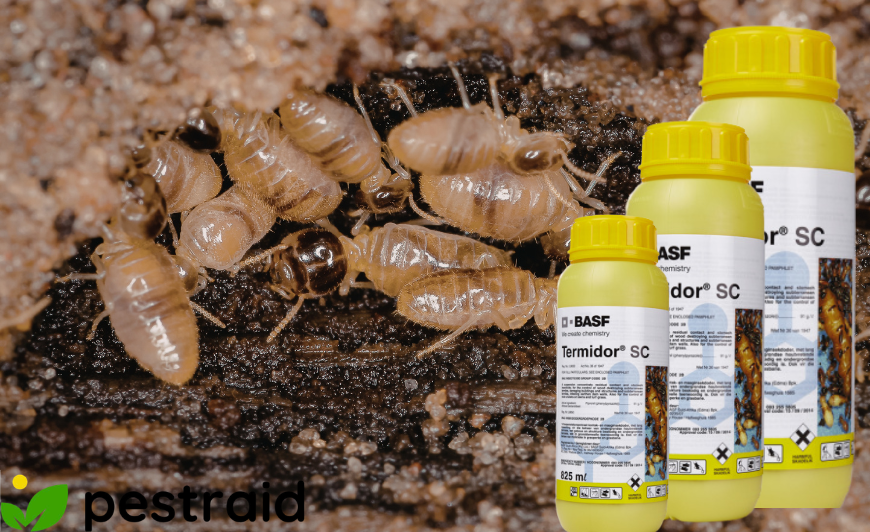
🥇 #1 Best Overall: Termidor SC (Fipronil 9.1%)
Termidor SC is the most effective termite treatment product available in Kenya and is the professional industry gold standard worldwide. Unlike repellent termiticides that simply create a barrier, Termidor works through a revolutionary “Transfer Effect” — termites that contact the treated soil zone do not die immediately. Instead, they carry the fipronil back to the nest on their bodies, spreading it to nestmates through grooming and food sharing. Within weeks, the entire colony — including the queen — is eliminated.
Why Pestraid Kenya recommends it:
- Eliminates the entire colony, not just foraging workers
- Undetectable by termites — they do not avoid treated zones
- 10+ year residual effectiveness in soil
- Registered and approved for use in Kenya
- Effective at very low concentrations — minimising environmental impact
Best for: Post-construction soil barrier treatment for existing buildings with subterranean termites.
🥈 #2 Best for Wood Protection: Tim-Bor (Disodium Octaborate)
Tim-Bor is a professional boron-based wood preservative and termiticide that is dissolved in water and applied directly to timber surfaces. It penetrates deep into the wood, killing any termites that feed on treated timber while also preventing future attack. It is odourless, colourless, low in toxicity to humans and animals, and does not affect the appearance of timber.
Why Pestraid Kenya recommends it:
- Deep penetration into timber for long-lasting protection
- Kills termites, fungi, and wood-boring beetles simultaneously
- Safe for indoor use — no harmful fumes
- Ideal for treating roof trusses, wall plates, and furniture
- Can be applied to new or existing timber
Best for: Roof structure timber treatment, furniture protection, boron treatment of all exposed wood.
🥉 #3 Best for New Construction: Biflex Ultra SC (Bifenthrin)
Biflex Ultra SC is a premier bifenthrin-based termiticide ideal for pre-construction soil treatment. Applied to the soil under slabs and around foundations before pouring, it creates a long-lasting chemical barrier that prevents termites from entering the structure from below. It is one of the most widely used products by professional building contractors across Kenya.
Why Pestraid Kenya recommends it:
- Specifically formulated for pre-construction soil treatment
- 5–10 year residual protection in Kenyan soil conditions
- Repellent action — termites immediately avoid treated zones
- Fast-acting and easy to apply at the construction stage
- Protects the entire building perimeter and sub-floor
Best for: Pre-construction treatment of new buildings, renovation projects.
🏅 #4 Best for Ongoing Colony Monitoring: Sentricon Bait System
The Sentricon Bait System takes a completely different approach to termite control. Instead of applying chemicals to the soil, bait stations containing a slow-acting insect growth regulator (Noviflumuron) are installed in the ground around the property. Foraging termites find the bait, feed on it, and share it with the colony. The growth regulator prevents young termites from moulting — they cannot grow into adults, the colony shrinks, and eventually collapses.
Why Pestraid Kenya recommends it:
- Zero chemical application to soil or structure
- Continuous monitoring detects new termite activity automatically
- Eliminates the entire colony including the queen
- Environmentally responsible — extremely low toxicity
- Ideal for properties near water sources, gardens, or organic farms
Best for: Ongoing termite monitoring programs, environmentally sensitive properties, hotels, and schools.
📞 To order termite control products or book a professional treatment, contact Pestraid Kenya:
- Phone / WhatsApp: 0710907628
- Email: sales@pestraid.co.ke
8. Step-by-Step Professional Termite Treatment Process
When Pestraid Kenya carries out a professional termite treatment, we follow a systematic process to ensure complete and long-lasting elimination. Here is exactly what happens:
Step 1: Full Property Inspection Our certified technician conducts a thorough inspection of the entire property — inside and outside. We check all timber elements, the foundation perimeter, sub-floor (if accessible), roof void, garden fencing, and any trees or stumps near the building. We identify the termite species, locate all active infestation points, and map the extent of the colony’s foraging activity.
Step 2: Species and Infestation Assessment Based on the inspection, we determine whether the infestation is subterranean (soil-based), drywood (within wood only), or both. This directly determines which treatment method and products are selected.
Step 3: Soil Barrier Treatment (Subterranean Termites) For subterranean termites, we apply a liquid termiticide (typically Termidor SC or Biflex Ultra) to the soil around and beneath the foundation. In post-construction treatment, this involves drilling holes at 300–500 mm intervals along the internal and external foundation walls, injecting the termiticide under pressure into the soil, and sealing the holes. This creates a continuous chemical barrier that either repels or eliminates termites attempting to enter the structure.
Step 4: Wood Treatment All accessible infested or at-risk timber is treated with boron solution (Tim-Bor) or a residual termiticide. This includes roof trusses, wall plates, skirting boards, door and window frames, and any exposed structural timber. Heavily infested timber sections may need to be removed and replaced before treatment.
Step 5: Spot Treatment of Active Galleries Active termite workings inside walls, floors, or furniture are injected directly with a contact termiticide using a foam applicator. This kills termites present in the gallery immediately and leaves a residual barrier inside the timber.
Step 6: Bait Station Installation (Where Required) For ongoing colony elimination and monitoring, Sentricon or equivalent bait stations are installed at strategic intervals around the property perimeter — typically every 3 metres in high-risk zones.
Step 7: Post-Treatment Report Pestraid Kenya provides a written treatment report documenting the infestation findings, all areas treated, products used, and recommendations for follow-up inspections. This report is often required by banks for mortgage purposes and by property managers for building compliance.
Step 8: Follow-Up Inspection We schedule a follow-up inspection 30–90 days after treatment to verify that all termite activity has ceased, assess bait station uptake, and ensure the chemical barrier is intact.
9. DIY Termite Control: What Works and What Doesn’t
Many Kenyan homeowners attempt DIY termite control before calling a professional. Here is an honest assessment of what is effective and what is not:
| DIY Method | Does It Work? | Limitations |
|---|---|---|
| Pouring boiling water into mound or galleries | Partially | Only kills termites it directly contacts — misses the colony |
| Applying used motor oil to timber | No | Toxic, fire risk, no proven termiticide effect |
| Kerosene or diesel poured into soil | No | Highly toxic, fire risk, does not penetrate soil effectively |
| Supermarket ant/insect sprays | No | Not formulated for termites — no soil penetration |
| Orange oil (D-limonene) | Partially | Limited to drywood termites in accessible wood only |
| Diatomaceous Earth | Partially | Effective only on termites that directly contact it |
| Boron wood treatment (DIY) | Yes — partially | Effective on exposed accessible timber, but requires correct concentration and application |
| Professional-grade termiticide (DIY purchase) | Yes — with caution | Effective if correctly diluted and applied to the right depth and volume of soil |
Pestraid Kenya’s honest advice: DIY termite control can be effective for very early-stage, localised wood infestations using boron treatments. However, for any subterranean termite infestation — which represents the vast majority of cases in Kenya — professional soil treatment is essential. The soil injection process requires specialist equipment, correct chemical volumes per square metre of soil, and the expertise to create a continuous barrier with no gaps. A gap as small as 15 cm in the barrier is sufficient for termites to find their way through.
10. How to Protect a New Building from Termites in Kenya
Pre-construction termite treatment is far more effective and far less expensive than treating an existing infested structure. If you are building a new home, commercial property, or extension in Kenya, insist on the following:
Pre-Construction Soil Treatment Before the concrete slab or foundation is poured, the entire sub-slab soil area should be treated with a registered termiticide (Biflex Ultra or Chlorpyrifos 48% EC). This is applied at a rate of 5 litres per square metre of soil to a depth of 150 mm. The chemical barrier must be continuous with no gaps.
Foundation Wall Treatment The inside and outside faces of all foundation walls should be treated with termiticide before backfilling. This prevents termites from entering through the foundation join — one of the most common entry points in Kenyan construction.
Timber Pre-Treatment All structural timber used in the building — roof trusses, wall plates, floor joists — should be pressure-treated with a boron-based preservative (Tim-Bor) or an approved timber preservative before installation.
Physical Barriers Consider installing Termi-mesh (stainless steel mesh) at all soil-to-structure penetration points — plumbing and electrical conduit entry points, slab edges, and expansion joints. Physical barriers require no chemical maintenance and last the lifetime of the building.
Post-Construction Soil Perimeter Treatment After construction is complete, treat the soil perimeter around the external foundation wall to a depth of 500 mm as a final barrier reinforcement.
Important: Under Kenya’s Building Code, soil pre-treatment for termites is a requirement for building approval in many counties, particularly in high-risk areas. Always request a treatment certificate from your pest control company to submit with your building documentation.
11. How to Prevent Termites from Returning
After successful treatment, the following measures will significantly reduce the risk of re-infestation:
| Prevention Action | Details | Priority |
|---|---|---|
| Fix all plumbing leaks immediately | Moisture is the primary attractant for subterranean termites — eliminate all water sources | Critical |
| Ensure proper drainage around the foundation | Grade soil so water flows away from the building — do not allow pooling near walls | Critical |
| Remove all timber in contact with soil | Wooden garden borders, old stumps, timber offcuts stored against the foundation | High |
| Store firewood away from the structure | Stack firewood at least 5 metres from the building on a raised platform | High |
| Remove dead trees and stumps from the garden | Old stumps are prime nesting sites for Macrotermes and subterranean termites | High |
| Seal all cracks in the foundation and walls | Even hairline cracks provide termite entry points — seal with epoxy or cement | High |
| Schedule annual termite inspections with Pestraid Kenya | Early detection prevents re-infestation from becoming severe | Essential |
| Maintain chemical soil barrier renewal | Soil barriers need renewal every 5–10 years depending on the product used | Essential |
| Avoid planting trees close to the foundation | Tree roots disturb soil barriers and provide termite pathways | Moderate |
| Use termite-resistant timber in any new construction or renovation | Hardwoods such as Meru Oak and treated timber resist termite attack | Moderate |
12. Frequently Asked Questions
How much does termite treatment cost in Kenya?
Professional termite treatment in Kenya ranges from KSh 5,000 for spot wood treatments to KSh 80,000+ for full soil barrier treatment of a large property. Pre-construction soil treatment typically costs KSh 15,000–KSh 40,000 depending on the floor area. Contact Pestraid Kenya at 0710907628 for a free site inspection and quote.
How long does termite treatment last in Kenya?
Soil barrier treatments using premium termiticides like Termidor SC last 10+ years. Bifenthrin-based barriers last 5–10 years. Boron wood treatments last 5–15 years in protected timber. Annual inspections are recommended regardless of the treatment type to detect any new activity early.
Are the chemicals used in termite treatment safe for my family?
Professional termiticides are applied at very low concentrations in soil or timber — not as airborne sprays in living spaces. When applied by trained technicians following label protocols, they pose no risk to occupants. We advise staying off treated soil areas until they are dry. Boron wood treatments are extremely low in toxicity and safe around children and pets.
Can termites come back after professional treatment?
Termites can return if the chemical barrier degrades over time, if new colonies establish nearby, or if the original treatment had gaps. This is why annual inspections are essential. Pestraid Kenya offers maintenance inspection programmes to ensure your protection remains effective year after year.
What is the difference between termites and ants?
Winged termites (alates) are commonly confused with flying ants. Key differences: termites have a straight, thick waist, straight antennae, and two pairs of equal-length wings. Flying ants have a pinched waist, elbowed antennae, and wings of unequal length. Finding discarded equal-length wings near windows is a strong indicator of termite swarming.
How quickly can termites destroy a house in Kenya?
In Kenya’s climate, a large, established Macrotermes or subterranean termite colony can cause significant structural damage within 3–5 years. Roof timbers can be fully hollowed out in as little as 2 years if conditions are favourable. This is why early detection and treatment are critical.
Do I need to vacate my home during termite treatment?
For soil injection treatments, you do not need to vacate. Technicians will work around occupied spaces, and there is no significant airborne chemical exposure in living areas. For tent fumigation treatments (drywood termites), you would need to vacate for 24–48 hours. Your Pestraid Kenya technician will advise you based on the specific treatment plan.
What are the mud tubes I see on my walls?
Mud tubes (also called shelter tubes or termite highways) are pencil-thin tunnels made from soil, wood particles, and termite saliva. Subterranean termites build them to travel between their underground colony and their food source (your timber) while staying protected from light and dry air. Finding mud tubes is one of the clearest signs of an active subterranean termite infestation.
Can I treat termites myself in Kenya?
Limited DIY treatment is possible for early-stage drywood termite infestations using boron-based wood treatments. However, subterranean termite infestations — which require precise soil injection treatment — should always be handled by a licensed professional. Incorrect DIY soil treatment creates gaps in the barrier that termites will exploit. Contact Pestraid Kenya for a professional assessment before attempting any treatment.
13. Contact Pestraid Kenya — Professional Termite Control
Pestraid Kenya is one of Kenya’s most trusted pest control companies, providing certified termite inspection, treatment, and prevention services to homeowners, developers, landlords, hotels, hospitals, and commercial properties across Kenya.
Our termite control services include:
- Free property inspection and termite risk assessment
- Pre-construction soil barrier treatment with treatment certificates
- Post-construction soil injection treatment for existing buildings
- Boron wood treatment for roofing, furniture, and structural timber
- Termite bait station installation and monitoring programmes
- Annual inspection and maintenance contracts
- Written treatment reports accepted by banks, valuers, and property managers
📞 Phone / WhatsApp: 0710907628 ✉️ Email: sales@pestraid.co.ke 🏢 Brand: Pestraid Kenya
Do not wait until termites have caused expensive structural damage. A professional inspection from Pestraid Kenya takes less than an hour and could save you hundreds of thousands of shillings in future repair costs.
Call Pestraid Kenya today on 0710907628 — Kenya’s trusted termite control experts.
Pestraid Kenya — Your Trusted Pest Control Partner in Kenya | sales@pestraid.co.ke | 0710907628